


10 Science-Backed Green Gram Benefits (Whole Moong) for Health & Weight Loss

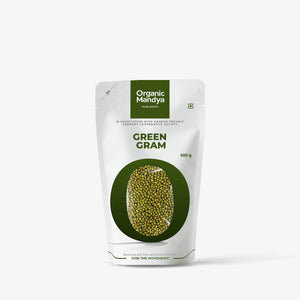
Green gram (whole moong, Vigna radiata) is India's most complete pulse: it provides 24 g protein, 16 g dietary fibre, 6.7 mg iron, 625 mcg folate, and a glycaemic index of approximately 25 per 100 g raw according to the ICMR's Indian Food Composition Tables 2017. As sabut (whole) moong with its green husk intact, it delivers polyphenol antioxidants, resistant starch, and prebiotic fibre absent in split yellow moong dal. In Ayurveda, whole moong is classified as the only tridoshic pulse safe for every body constitution, every season, and every age group. Modern nutritional science confirms why.
Buy from Organic Mandya


What Is Green Gram (Whole Moong)?
Whole green gram (sabut moong) is the unhusked, unsplit form of the mung bean (Vigna radiata), the same species as yellow moong dal, with the critical difference that the green outer husk is retained. This husk is where the polyphenols, resistant starch, and additional fibre are concentrated, making whole moong nutritionally superior to its husked yellow counterpart on several parameters beyond protein.
Green gram across Indian languages:
| Language | Name |
|---|---|
| Hindi | Sabut moong / Hari moong |
| Kannada | Hesarukalu / HireMoong |
| Tamil | Pachai payaru |
| Telugu | Pesalu |
| Marathi | Mung / Hirwa mung |
| Bengali | Sona moong / Hari moong |
| Sanskrit | Mudga (Ayurvedic texts) |
In Ayurveda, moong is called mudga, the Sanskrit term appearing in both the Charaka Samhita and Ashtanga Hridayam as a prescribed food for patients, convalescents, and as the base of khichdi (the original hospital food of Indian civilisation).
Learn more about Masoor Dal Protein per 100g and discover its protein content, calories, fiber, and key nutrients that make it a valuable addition to a balanced diet.
Nutritional Profile per 100g
Source: ICMR Indian Food Composition Tables 2017. Per 100 g raw, whole green gram (sabut moong).
| Nutrient | Per 100 g | % Adult Daily RDA | Notes |
|---|---|---|---|
| Energy (kcal) | 334 | 17% | Slightly lower than yellow moong (348) - husk adds fibre, not calories |
| Protein (g) | 24 | 43% (women) | High-quality plant protein |
| Carbohydrates (g) | 56.7 | - | Complex, slow-release |
| Dietary Fibre (g) | 16.0 | 64% | Very high; both soluble and insoluble |
| Fat (g) | 1.3 | 2% | Negligible |
| Iron (mg) | 6.7 | 37% (women) | Non-haem; enhance with Vitamin C |
| Folate (mcg) | 625 | 156% | Highest of common Indian dals |
| Potassium (mg) | 1,246 | 26% | Highest of common Indian dals |
| Magnesium (mg) | 189 | 47% | Muscle, nerve, blood sugar |
| Zinc (mg) | 2.7 | 25% | Immune, skin, protein synthesis |
| GI | ~25 | - | Very Low - lower than yellow moong (~38) |
| Polyphenols | Significant | - | From green husk, antioxidant, anti-inflammatory |
The husk advantage: Whole green gram's GI (~25) is lower than split yellow moong's (~38) because the intact husk acts as a physical barrier, slowing starch digestion. The husk also contributes additional soluble fibre, resistant starch, and polyphenol antioxidants that are stripped away in husked yellow moong dal.
Read our detailed guide on Moong Dal Protein per 100g to understand its nutritional composition and how it can fit into a healthy everyday diet.
The 10 Science-Backed Benefits of Green Gram
Benefit 1: Weight Loss and Appetite Control
Whole green gram is one of the most effective natural weight management foods in the Indian diet, for three compounding reasons. First, it's 16 g of dietary fibre per 100 g (the highest of common Indian dals), which creates significant physical satiety through stomach distension and delayed gastric emptying. Second, it's 24 g of protein per 100 g, which stimulates satiety hormones (GLP-1, PYY) that suppress appetite for 3-4 hours. Third, it's very low GI (~25), which prevents the post-meal glucose spike that triggers fat storage and subsequent hunger.
A 200 g bowl of cooked whole moong (from 75 g dry) provides approximately 18 g protein, 12 g fibre, and only 165 kcal, a satiety-to-calorie ratio that few Indian foods match. Substituting white rice or wheat-based breakfast with whole moong sprouts or moong khichdi produces a consistent caloric deficit without hunger.
Benefit 2: Blood Sugar Control (Diabetes Management)
With a GI of approximately 25, whole green gram is one of the lowest-glycaemic foods in the Indian diet, lower than even its split yellow counterpart (~38), brown rice (~55), and dramatically lower than white rice (~73). Its combination of soluble fibre, resistant starch, and protein creates a multi-layered blood sugar protection mechanism: the fibre slows glucose absorption, the resistant starch bypasses small intestinal digestion entirely (no glucose release), and the protein stimulates insulin-independent glucose uptake in muscle cells.
The ICMR-NIN Dietary Guidelines 2024 specifically recommend whole pulses as the dietary cornerstone for blood sugar management in type 2 diabetic and pre-diabetic Indians. Sprouted green gram has an even lower effective GI as sprouting converts additional starch to resistant starch.
Benefit 3: Heart Health
Green gram supports cardiovascular health through three simultaneous mechanisms. Its soluble fibre binds bile acids in the intestine, interrupting LDL cholesterol recirculation. It's potassium (1,246 mg/100g the highest of common Indian dals) counters dietary sodium's vasoconstrictive effect, supporting healthy blood pressure. Its flavonoid polyphenols (from the green husk) reduce LDL oxidation the primary mechanism of atherosclerotic plaque formation.
Published research on mung bean interventions confirms reductions in total cholesterol, LDL cholesterol, and systolic blood pressure in hyperlipidaemic subjects after 8-12 weeks of regular consumption.
Benefit 4: Digestive Health and Gut Microbiome
Whole green gram is exceptional for gut health for two distinct reasons. First, its soluble fibre (primarily pectin and hemicellulose) ferments in the large intestine, feeding Bifidobacterium and Lactobacillus species, the beneficial bacteria associated with reduced bowel disease risk, improved immunity, and better mood regulation. Second, its resistant starch reaches the colon intact, producing butyrate (the short-chain fatty acid that feeds colonocytes, reduces colon cancer risk, and maintains the gut barrier).
The Ayurvedic prescription of moong dal khichdi during illness is nutritionally grounded in precisely this easy digestibility + gut-nourishing combination.
Benefit 5: Plant Protein for Muscle and Recovery
At 24 g protein per 100 g (equivalent to many meat sources per calorie), whole green gram delivers the leucine, lysine, and BCAAs required for muscle protein synthesis - particularly when paired with rice or roti (complementary amino acid profiles that correct moong's limiting methionine). Sprouted green gram is the superior post-workout form: sprouting generates Vitamin C (improving iron absorption for haemoglobin production) and reduces phytic acid (improving zinc bioavailability for testosterone and muscle enzyme function). A 2026 study published in Frontiers in Nutrition (Varshanath et al., DOI: 10.3389/fnut. 2026.1756171) confirmed that combining cooked green gram with buttermilk (takra) significantly improved iron, zinc, and calcium bioaccessibility validating the traditional Ayurvedic practice of serving moong with curd or buttermilk to maximise mineral absorption.
Benefit 6: Detoxification Support
Green gram's polyphenols and flavonoids concentrated in the green husk support Phase II liver detoxification by upregulating glutathione S-transferase enzymes. Multiple in vitro and animal studies confirm that Vigna radiata extracts significantly increase hepatic antioxidant enzyme activity and reduce oxidative liver stress markers. The traditional Indian "moong water fast" (consuming only moong dal soup or sprouted moong for 1-3 days) is a time-tested detox protocol with this hepatoprotective mechanism as its biochemical basis.
Benefit 7: Reduces Inflammation
Whole green gram contains several anti-inflammatory compounds, specifically concentrated in the husk: vitexin, isovitexin, quercetin, kaempferol, and caffeic acid. These flavonoids inhibit NF-kB (the master regulator of inflammatory gene expression), reduce TNF-alpha and IL-6 (pro-inflammatory cytokines), and modulate the arachidonic acid pathway. Regular whole moong consumption is associated with lower systemic inflammatory markers relevant for managing conditions driven by chronic low-grade inflammation, including diabetes, obesity, and cardiovascular disease.
Benefit 8: Skin Health
Green gram supports skin health through two distinct pathways. Internally, it's 625 mcg folate per 100 g, which supports rapid skin cell turnover and repair; its zinc (2.7 mg/100g) regulates sebum production and accelerates wound healing; and its Vitamin C (generated during sprouting) directly drives collagen synthesis. Externally: traditional Indian skincare has used green gram flour (moong flour) as a face wash and mask for centuries - its saponins gently cleanse pores, its proteins nourish skin cells, and its anti-inflammatory flavonoids reduce redness.
Benefit 9: Pregnancy and Lactation Benefits
Green gram is one of Ayurveda's most prescribed foods during pregnancy and lactation. The modern nutritional rationale: its 625 mcg folate per 100 g directly prevents neural tube defects in early pregnancy (the ICMR recommends 500 mcg folate/day for pregnant women); its iron (6.7 mg/100g) addresses gestational anaemia; its calcium and phosphorus support foetal bone development; and its easy digestibility makes it suitable even during first-trimester nausea. For lactating mothers, moong's protein supports milk production, and its cooling (sheetala) Ayurvedic classification reduces postpartum pitta-related heat.
Benefit 10: Immune System Support
Green gram's combination of zinc (2.7 mg/100g - 25% of daily RDA), iron (6.7 mg - 37% of RDA), folate (156% of RDA), and flavonoid antioxidants provides broad immune system support: zinc activates T-lymphocytes; iron supports neutrophil function and oxygen delivery to immune cells; folate is required for rapid lymphocyte cell division during immune responses; and flavonoids directly inhibit viral replication in published in vitro studies. Sprouted green gram additionally contributes Vitamin C - the primary immune-activating micronutrient absent in dry or cooked moong.
Explore our detailed guide on Rajma Nutritional Value per 100g to learn about its calories, protein, fiber, carbohydrates, and essential nutrients.
Green Gram vs Split Moong vs Other Pulses
Source: ICMR Indian Food Composition Tables 2017. Per 100 g raw, dry.
| Feature | Whole Green Gram | Yellow Split Moong | Masoor Dal | Chana Dal |
|---|---|---|---|---|
| Protein (g) | 24 | 24 | 25 | 20 |
| Fibre (g) | 16.0 | 16.3 | 11.5 | 12.0 |
| GI | ~25 | ~38 | ~28 | ~8-11 |
| Folate (mcg) | 625 | 625 | 479 | 340 |
| Iron (mg) | 6.7 | 6.7 | 7.6 | 4.9 |
| Polyphenols | High (green husk) | Low (husk removed) | Medium | Medium |
| Digestibility | Moderate | High | High | Moderate |
| Cook time | 25-35 min (soaked) | 10-15 min | 15 min | 25-30 min |
| Sproutable | Yes - best sprouting dal | Partially | No | No |
| Best for | Weight loss, sprouting, diabetes, and heart | Post-illness, infants, convalescence | Protein + iron, fast cooking | Blood sugar control |
The whole vs split verdict: Whole green gram is nutritionally superior to split yellow moong on GI (~25 vs ~38), polyphenol content, and suitability for sprouting. Yellow moong is superior in digestibility and cook time. For healthy adults with no digestive concerns, whole green gram is the better daily choice.
How to Use Green Gram: Sprouted, Soaked, and Cooked
Method 1: Sprouted Green Gram (Maximum Nutrition)
Sprouting is the highest-value preparation for whole green gram it reduces phytic acid by 40-50%, generates Vitamin C, improves protein bioavailability, and creates a fresh, crunchy ingredient for salads and chaats.
Steps:
- Rinse 100 g of whole green gram 3 times. Soak in 300 ml of water overnight (8-10 hours).
- Drain completely. Transfer to a clean muslin cloth or colander. Cover loosely.
- Leave at room temperature (25-30 degrees C) for 24-48 hours. Rinse once at the 12-hour mark.
- Sprouts are ready when the tails are 1-2 cm long. Refrigerate and use within 3 days.
- Use in salads, chaats, stir-fries, or as a breakfast bowl with lemon, chaat masala, and grated coconut. For maximum mineral absorption, serve sprouted moong with a small amount of buttermilk or curd a combination validated by a 2026 study in Frontiers in Nutrition (DOI: 10.3389/fnut. 2026.1756171) confirming significantly improved iron, zinc, and calcium bioaccessibility when green gram is combined with buttermilk, aligning with the Ayurvedic tradition of moong with takra.
Method 2: Moong Dal Khichdi (Tridoshic Healing Meal)
Equal parts (50 g each) whole green gram + rice, pressure-cooked with turmeric, cumin, ginger, and salt. Add a ghee tadka. This is Ayurveda's most prescribed therapeutic meal - easy to digest, nutritionally complete, tridoshic, and appropriate for illness recovery, post-surgery, and daily consumption.
Method 3: Overnight Soaked Moong (Pre-Breakfast Protein)
Soak 30 g of whole green gram overnight. Drain and eat raw with lemon, salt, and grated ginger as the first food in the morning. 30 g of soaked moong provides approximately 6 g of protein, 3 g of fibre, and 1.2 mg of iron with improved bioavailability from overnight phytic acid reduction.
Daily Dosage and Best Time
| Goal | Daily Amount | Best Form | Timing |
|---|---|---|---|
| General health | 50-75 g dry | Cooked dal or khichdi | Lunch or dinner |
| Weight loss | 75-100 g dry | Sprouted or soaked | Breakfast or pre-meal |
| Diabetes management | 50-75 g dry | Whole cooked (not split) | With every main meal |
| Muscle building | 100-150 g dry | Mixed forms | Across 2-3 meals daily |
| Pregnancy/folate | 75-100 g dry | Cooked khichdi | Lunch + dinner |
| Post-illness recovery | 50 g dry | Moong khichdi (well-cooked) | Twice daily |
| Skin health | 50 g dry + topical use | Sprouted internal + flour external | Morning |
Side Effects and Precautions
Green gram is one of the safest pulses for daily consumption. Three minor precautions:
- Bloating in first-time high-fibre consumers: The 16 g of fibre per 100 g can cause flatulence when introduced suddenly. Start with 30-40 g/day and increase over 1-2 weeks. Soaking overnight and discarding the soaking water significantly reduces gas-causing oligosaccharides.
- Kidney disease (CKD): Green gram's potassium (1,246 mg/100g) and phosphorus (367 mg/100g) require physician guidance for patients with CKD on mineral restriction.
- Drug interactions (rare): No established drug interactions with whole green gram at dietary amounts. Therapeutic-dose green gram extract supplements may interact with anticoagulants. Consult a physician.
Add green gram to your week
FAQs
Q1. What are the main green gram benefits?
The 10 main green gram (whole moong) benefits are: (1) weight loss through protein and fibre satiety; (2) blood sugar control via very low GI (~25) and resistant starch; (3) heart health through soluble fibre cholesterol reduction and potassium; (4) digestive health via prebiotic fibre and resistant starch; (5) plant protein for muscle and recovery (24 g/100g); (6) detoxification support through flavonoid activation of liver enzymes; (7) anti-inflammatory action via green husk polyphenols; (8) skin health through folate, zinc, and collagen-building Vitamin C in sprouted form; (9) pregnancy and lactation benefits via 625 mcg folate and 6.7 mg iron; and (10) immune system support through zinc, iron, folate, and flavonoids. Source: ICMR IFCTs 2017 and published Vigna radiata pharmacological research.
Q2. Is green gram good for weight loss?
Yes, whole green gram is one of the best foods for weight loss in the Indian diet. A 200 g bowl of cooked whole moong (from 75 g dry) provides ~18 g protein, ~12 g fibre, and only ~165 kcal, a satiety-to-calorie ratio unmatched by most Indian breakfast or lunch foods. It's very low GI (~25), which prevents blood sugar spikes and subsequent hunger. Sprouted green gram as a breakfast chaat is even more effective: raw sprouted moong provides maximum fibre, protein, and Vitamin C at approximately 30 kcal per 100 g fresh weight.
Q3. Is green gram good for diabetes?
Yes, whole green gram is among the most diabetes-friendly foods in Indian cuisine. Its glycaemic index of approximately 25 is one of the lowest of any common Indian food, dramatically lower than white rice (~73), wheat roti (~70), or even oats (~55). Its soluble fibre, resistant starch, and protein create multiple overlapping mechanisms to slow glucose absorption and improve insulin sensitivity. The ICMR-NIN Dietary Guidelines 2024 recommend daily whole pulse consumption as the cornerstone of diabetic Indian diets. Use whole green moong rather than split yellow moong for the additional GI advantage (~25 vs ~38).
Q4. How to sprout green gram at home?
Sprouting whole green gram at home takes 24-48 hours and requires no special equipment. Rinse 100 g green gram, soak overnight in 300 ml water, drain, wrap in a damp cloth or place in a colander, and leave at room temperature for 24-48 hours until 1-2 cm tails appear. Rinse once at the 12-hour mark. Refrigerate finished sprouts and use within 3 days. Sprouted green gram has 40-50% less phytic acid than dry moong, generates Vitamin C (absent in dry or cooked moong), and improves protein and mineral bioavailability.
About This Article
Sources:
- ICMR (Indian Council of Medical Research) - Indian Food Composition Tables 2017, National Institute of Nutrition, Hyderabad. Primary source for all nutritional values: protein (24 g/100g), iron (6.7 mg), folate (625 mcg), fibre (16 g), potassium (1,246 mg), GI (~25), calories (334 kcal) per 100 g raw whole green gram.
- ICMR-NIN - Dietary Guidelines for Indians, 2024. Source for daily pulse recommendations, blood sugar management guidance, and pregnancy folate requirements.
- Charaka Samhita and Ashtanga Hridayam - Classical Ayurvedic texts. Source for mudga (moong) tridoshic classification, sheetala property, and therapeutic food applications.
- Published research on Vigna radiata - Multiple peer-reviewed studies on mung bean anti-inflammatory flavonoids (vitexin, isovitexin), cholesterol-lowering effects, and hepatoprotective polyphenols.
- Published research on legume sprouting - Multiple peer-reviewed studies confirming 40-50% phytic acid reduction through sprouting, Vitamin C generation, and improved mineral bioavailability.
- Varshanath B, Robin DT, Meera S, et al. - Enhancement of iron, zinc, and calcium bioaccessibility and bioavailability in green gram (Vigna radiata L.) supplemented with buttermilk through phytate reduction: an in vitro dietary evaluation, Frontiers in Nutrition, 2026, DOI: 10.3389/fnut. 2026.1756171. Source for buttermilk-moong mineral absorption synergy (Benefit 5 and sprouting guide).
- International Tables of Glycemic Index and Glycemic Load Values (Atkinson FS, Foster-Powell K, Brand-Miller JC, Diabetes Care, 2008). Source for GI values (whole green moong ~25, yellow moong ~38).


