


Moong Dal Protein per 100g: Detailed Macronutrient Profile

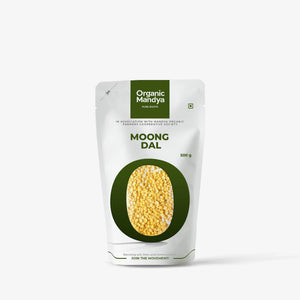
Moong dal (green gram, Vigna radiata) contains 24 grams of protein per 100 grams of raw, dry split yellow dal, making it one of the highest-protein Indian dals alongside masoor (25 g) and urad (25 g). According to the ICMR's Indian Food Composition Tables 2017, whole green moong provides 24 g protein, split yellow moong 24 g, and sprouted moong approximately 3.8 g per 100 g fresh weight (equivalent to 21-23 g on a dry-weight basis). Moong dal is also Ayurveda's only tridoshic pulse, the one dal that balances all three doshas and is safe for virtually every body constitution, making it the most universally recommended dal in classical Indian medicine.
Buy moong dal from Organic Mandya


Moong Dal Protein per 100 g
Yellow moong dal (split, husked): 24 g protein per 100 g raw
Source: ICMR Indian Food Composition Tables 2017
| Form | Protein per 100g | Calories | Fibre | Iron | GI |
|---|---|---|---|---|---|
| Yellow moong dal (raw, dry) | 24 g | 348 kcal | 16.3 g | 6.7 mg | ~38 |
| Whole green moong (raw, dry) | 24 g | 334 kcal | 16.0 g | 6.7 mg | ~25 |
| Cooked yellow moong dal (per 100 g) | ~8 g | ~115 kcal | ~5.5 g | ~2.2 mg | ~38 |
| Sprouted green moong (per 100g fresh) | ~3.8 g | ~30 kcal | ~1.8 g | ~0.9 mg | ~25 |
| Sprouted moong (dry-weight equivalent) | ~22 g | - | - | - | Improved |
Practical serving sizes:
| Serving | Protein | Calories | Notes |
|---|---|---|---|
| 50 g dry yellow moong (1 katori) | 12 g | 174 kcal | Cooks to ~200 g; standard lunch serving |
| 200 g cooked moong dal | ~16 g | ~230 kcal | One full bowl of dal |
| 100 g sprouted moong | ~3.8 g | ~30 kcal | Salad/chaat serving |
| 30 g dry moong (breakfast porridge) | 7.2 g | 104 kcal | Moong khichdi or porridge base |
Yellow Moong vs Green Moong vs Whole Moong: The Three-Way Comparison
This is the comparison most moong dal articles miss entirely. The three market forms of moong are nutritionally distinct enough to matter for specific health goals.
Source: ICMR Indian Food Composition Tables 2017. Per 100 g raw, dry.
| Attribute | Yellow Moong (split, husked) | Green Moong (split, with husk) | Whole Green Moong (sabut) |
|---|---|---|---|
| Protein (g) | 24 | 24 | 24 |
| Dietary Fibre (g) | 16.3 | ~18 | 16.0 |
| Iron (mg) | 6.7 | ~7.0 | 6.7 |
| Calories (kcal) | 348 | ~340 | 334 |
| GI | ~38 | ~28 | ~25 |
| Cook time | 10-15 min | 15-20 min | 25-35 min (or overnight soak + 20 min) |
| Digestibility | Highest - no husk | High | Moderate - husk requires more digestion |
| Phytic acid | Lower (husked) | Medium | Higher (intact husk) |
| Antioxidants | Lower | Higher (husk polyphenols) | Highest |
| Best for | Post-illness, convalescence, infant food | Every day dal, gut health | Sprouting, gym/athletes, weight management |
| Ayurvedic classification | Laghu (light), easily digestible | Slightly heavier | Best for sprouting; most nutritionally complete |
Key insight: All three forms provide equivalent protein (24 g/100g) - the differences are in fibre content, digestibility, phytic acid load, and antioxidant profile. Yellow moong dal is the most digestible (ideal for illness recovery, post-surgery, and infants). Whole green moong is the most nutritionally complete (best for sprouting, which further improves bioavailability).
If you're interested in its complete nutritional profile, explore our detailed guide on Masoor Dal Protein per 100g to understand how it can contribute to your daily protein intake and overall wellness.
Raw vs Cooked vs Sprouted: How Processing Changes Protein
| Processing Method | Protein Concentration | Bioavailability | Anti-Nutrients | Notes |
|---|---|---|---|---|
| Raw dry moong | 24 g/100g | Low (not eaten raw) | Phytic acid present | Reference point |
| Soaked (8 hrs) | ~18 g/100g | Improved | Phytic acid reduced ~25% | Weight increases from water |
| Pressure cooked | ~8-9 g/100g | Good | Further reduced | Standard kitchen method |
| Sprouted (24-48 hrs) | ~3.8 g/100g fresh (~22g dry equivalent) | Highest | Reduced ~50% | Vitamin C generated; best bioavailability |
| Fermented (as idli/dosa batter) | ~7-8 g/100g batter | Very high | Significantly reduced | Lactic acid bacteria further improve absorption |
The sprouting protein paradox: Sprouted moong appears to have much less protein per 100 g (3.8 g) than cooked moong (8 g). This is because sprouted moong is measured fresh with high water content (90%+). On a dry-weight basis, sprouted moong retains ~22 g protein per 100 g while also having dramatically improved bioavailability, reduced phytic acid, generated Vitamin C, and initiated enzymatic pre-digestion. For gym-goers and those maximising protein absorption efficiency, sprouted moong beats cooked moong in practical protein delivery per gram consumed.
Discover the science-backed Green Gram Benefits and learn why this nutrient-dense pulse is a valuable addition to healthy, everyday meals.
Full Nutritional Profile: Macros and Micros
Source: ICMR Indian Food Composition Tables 2017. Per 100 g raw, split yellow moong dal.
Macronutrients:
| Macro | Per 100 g | Notes |
|---|---|---|
| Energy (kcal) | 348 | Moderate; comparable to other dals |
| Protein (g) | 24 | Among the highest of common Indian dals |
| Carbohydrates (g) | 59.9 | Complex, slow-release |
| Dietary Fibre (g) | 16.3 | Highest of common Indian dals |
| Fat (g) | 1.2 | Very low; essentially fat-free |
Micronutrients:
| Micro | Per 100 g | % Adult Daily RDA | Significance |
|---|---|---|---|
| Iron (mg) | 6.7 | 37% (women) | Good plant-based iron; enhanced with Vitamin C |
| Folate / B9 (mcg) | 625 | 156% | Highest folate of common Indian dals |
| Potassium (mg) | 1246 | 26% | The highest potassium of common Indian dals; cardiovascular |
| Phosphorus (mg) | 367 | 52% | Bone health and energy metabolism |
| Magnesium (mg) | 189 | 47% | Muscle function, blood pressure, and sleep |
| Calcium (mg) | 73 | 7% | Modest; complement with dairy or ragi |
| Zinc (mg) | 2.7 | 25% | Immune function, protein synthesis |
| Copper (mg) | 0.94 | 104% | Iron metabolism, connective tissue |
| Glycaemic Index | ~38 | - | Low; suitable for diabetics |
Four standout micronutrients:
- 625 mcg folate per 100 g - 156% of adult daily RDA; the highest folate of any common Indian dal. Critical for pregnant women, cell division, and homocysteine regulation.
- 1,246 mg potassium per 100 g - significantly higher than other common dals; important for blood pressure management in a high-sodium Indian diet.
- 16.3 g dietary fibre per 100 g - highest fibre of common Indian dals; both soluble (cholesterol-lowering, prebiotic) and insoluble (gut motility) fractions.
- GI ~38 - low glycaemic index; suitable for daily consumption by type 2 diabetics and pre-diabetics.
Why Moong Dal is Called Tridoshic
In Ayurvedic medicine, most foods aggravate at least one dosha (vata, pitta, kapha). Moong dal is exceptional; the Charaka Samhita and Ashtanga Hridayam both classify it as tridoshic (tri = three, doshic = dosha-balancing) - meaning it balances all three body constitutions simultaneously.
The modern nutritional basis for this classification:
- Vata pacifying: Moong's protein and complex carbohydrates provide grounding, sustaining energy that calms vata's lightness and instability
- Pitta pacifying: Moong is classified as sheetala (cooling) - its alkaline ash residue after digestion reduces the heat and acidity associated with pitta
- Kapha reducing: Moong's laghu (lightness) and low fat content prevent the heaviness and congestion associated with kapha accumulation
This is why moong dal khichdi is India's original sick-day food - prescribed for fever, post-surgery recovery, digestive illness, and postpartum care across all Ayurvedic traditions. Its easy digestibility, complete nutrition, and tridoshic nature make it the safest, most universally recommended protein source in classical Indian medicine.
Explore our detailed guide on Rajma Nutritional Value per 100g to learn about its protein content, calories, fiber, and essential minerals that make it a wholesome pantry staple.
How to Maximise Moong Dal Protein Absorption
5 strategies, ranked by impact:
1. Soak before cooking (30-60 minutes minimum). Reduces phytic acid by 20-25%, directly improving iron and zinc absorption from moong's already-significant mineral content. A 30-minute soak before pressure cooking takes negligible extra effort and produces measurably higher mineral bioavailability.
2. Sprout for 24-48 hours (highest bioavailability). Sprouting reduces phytic acid by 40-50%, generates Vitamin C (which triples non-haem iron absorption), and initiates enzymatic pre-digestion of proteins. Sprouted moong delivers more usable protein and minerals per serving than any other moong preparation. Instructions: soak 8 hours, drain, cover with a damp cloth, leave 24-48 hours until small tails appear.
3. Add Vitamin C at serving time. Squeeze lemon over cooked moong dal, add tomatoes to the preparation, or drink amla juice 20 minutes before the meal. This single step increases iron absorption 2-3 times through the Fe3+-to-Fe2+ conversion mechanism - particularly impactful given moong's 6.7 mg iron per 100 g.
4. Pair with a cereal (rice, roti, oats) for complete protein Moong dal's limiting amino acid is methionine and cysteine (sulphur amino acids). Cereals provide these readily. The traditional moong dal + rice combination creates a complete essential amino acid profile - the biochemical rationale behind khichdi's status as India's most perfect meal.
5. Use whole green moong over yellow for antioxidants The green husk of whole moong contains polyphenols absent in husked yellow moong. These antioxidants have anti-inflammatory and blood sugar-regulating properties beyond the protein content. Where digestibility allows, whole green moong is the nutritionally superior choice.
Sample Day with Moong Dal for 80g Protein Target
For a 70 kg moderately active adult targeting ~1.1 g protein per kg body weight = ~77-80 g/day. ICMR-NIN 2024 recommendation.
| Meal | Food | Protein |
|---|---|---|
| Breakfast (7 AM) | 30 g sattu sharbat + 50 g sprouted moong chaat | 7 g + 2 g = 9 g |
| Mid-morning (10 AM) | 150 g curd (dahi) | ~8 g |
| Lunch (1 PM) | 2 moong dal chillas (from 80 g moong dal) + roti | ~22 g |
| Afternoon snack (4 PM) | 30 g roasted moong or moong namkeen | ~7 g |
| Dinner (7 PM) | 1 katori moong dal khichdi (50 g moong + 50 g rice) + 100 g paneer sabzi | ~14 g + 18 g = 32 g |
| Total | ~78 g |
This sample day uses moong dal as the primary protein anchor at breakfast, lunch, and dinner, combined with curd and paneer for complete amino acid coverage and dairy protein diversity. See our [sattu protein per 100g guide] for how to substitute sattu across multiple meals for higher protein density.
If you're exploring traditional foods beyond a single dal or pulse, it's worth understanding how toor dal, moong dal, masoor dal, chana dal, urad dal, rajma, chickpeas, and other pulses compare. Read our Complete Dal and Pulses Guide to learn about the nutritional benefits of each variety, their everyday uses, cooking methods, and how to choose authentic, organically grown dals and pulses for your family's healthy meals.
Best Moong Dal Recipes for Maximum Protein
Moong Dal Chilla (Protein Pancake): Soak 80 g yellow moong dal for 2-3 hours, blend to a smooth batter with green chilli, ginger, and salt. Cook on a non-stick tawa like a dosa. Two large chillas = approximately 22 g protein. Add paneer stuffing for an additional 8-10 g per serving.
Sprouted Moong Salad Toss 150 g sprouted moong with chopped tomato, onion, cucumber, lemon juice, chaat masala, and coriander. 150 g serving = approximately 5.7 g protein with maximum bioavailability due to reduced phytic acid and generated Vitamin C.
Moong Dal Khichdi Cook equal parts (50 g each) yellow moong dal and rice with turmeric, cumin, and ghee. A 300 g cooked portion provides approximately 15 g protein as a complete protein (complementary amino acids from rice + moong). Add a tadka of ghee, mustard seeds, and asafoetida for flavour.
Add moong dal to your week
FAQs
Q1. How much protein is in moong dal per 100g?
Moong dal (green gram, Vigna radiata) contains 24 grams of protein per 100 grams of raw, dry split yellow dal, per the ICMR's Indian Food Composition Tables 2017. Whole green moong also provides 24 g/100g raw. When cooked, the concentration falls to approximately 8 g per 100 g of cooked dal, not because protein is lost, but because water absorption during cooking increases the total weight. A standard 50 g dry serving (1 katori) provides 12 g protein and cooks to approximately 200 g of dal.
Q2. Which has more protein - yellow moong or green moong?
Yellow moong dal (split, husked) and whole green moong both provide 24 g of protein per 100 g raw the protein content is identical. The differences are in digestibility (yellow moong is easier to digest due to husk removal), fibre (whole green moong retains slightly more fibre from the husk), antioxidants (green moong husk contains polyphenols absent in yellow), and GI (whole green moong has GI ~25 vs yellow moong's ~38). Choose yellow moong for easy digestion; choose whole green moong for sprouting and maximum antioxidants.
Q3. Is sprouted moong higher in protein?
Yes, on a bioavailability basis, though the raw numbers appear lower. Sprouted moong has approximately 3.8 g of protein per 100 g fresh weight, which seems low compared to cooked moong (8 g/100g). However, sprouted moong is 90% water by fresh weight; on a dry-weight equivalent basis, the protein is ~22 g, comparable to cooked moong. More importantly, sprouting reduces phytic acid by 40-50% and generates Vitamin C, making the protein and minerals significantly more bioavailable than in cooked moong. For maximum protein absorption efficiency, sprouted moong is the superior form.
Q4. Is moong dal good for muscle building?
Yes, moong dal is a good plant-based protein source for muscle building, though not as concentrated as whey protein. A 200 g bowl of cooked moong dal provides ~16 g protein, meaningful for daily muscle protein synthesis, especially when consumed within 30-60 minutes post-workout. For muscle building, pair with a cereal (rice or roti) for a complete amino acid profile, and use the higher-protein sprouted moong as a post-workout snack. Daily target for muscle building: 100-150 g dry moong dal distributed across 2-3 meals. The ICMR-NIN Dietary Guidelines 2024 recommend daily pulse consumption as the foundation of vegetarian protein adequacy.


