


Foxtail Millet (Navane): Your Complete Guide to Benefits, Nutrition & Uses

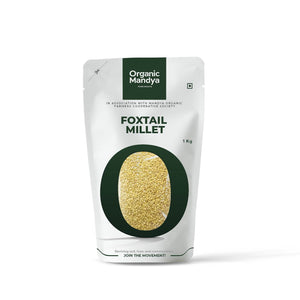
Foxtail millet (navane / thinai / kangni) is the millet that looks, cooks, and tastes closest to rice - making it the easiest rice replacement for Indian families. The small, golden grains cook in 15-20 minutes, fluff up like rice, absorb dal and sambar beautifully, and can replace rice in virtually any Indian meal. At 12.3 g protein (higher than rice by 81%), 8 g fibre (40x more than polished rice), and 2.8 mg iron per 100 g, foxtail millet delivers dramatically superior nutrition while maintaining the familiar rice-like eating experience. Organic Mandya's organic foxtail millet is sourced from certified organic farms in Karnataka, unpolished, and ready to cook as a direct rice substitute.
What Is Foxtail Millet (Navane)?
Foxtail Millet (Navane) is one of India's traditional grains - cultivated for thousands of years before rice and wheat monoculture replaced millet diversity across Indian agriculture. Millets are small-seeded grasses that grow with minimal water, no synthetic inputs, and remarkable resilience in poor soils. The Indian government declared 2023 as the International Year of Millets (IYoM) to revive these climate-smart, nutrient-dense grains.
Organic Mandya's organic foxtail millet (navane) is sourced from NPOP-certified organic farms, unpolished (retaining the fibre-rich bran layer), and lab-tested for pesticide residues. The grain is available as whole millet and as flour for versatile cooking applications.
How Is Organic Foxtail Millet (Navane) Different from Regular?
|
What We Are Comparing |
Organic Mandya |
Regular Market |
|
Farming |
Certified organic (NPOP); zero pesticides |
Conventional; pesticides possible |
|
Processing |
Unpolished (bran intact; full fibre + minerals) |
Often polished (bran removed) |
|
Fibre |
Full (bran layer retained) |
Reduced if polished |
|
Minerals |
Full iron, calcium, zinc (concentrated in bran) |
Lower if polished |
|
Colour |
Natural with bran specks |
Uniform if polished |
|
Certifications |
NPOP + FSSAI |
FSSAI only |
|
Lab reports |
trust.organicmandya.com |
Not published |
What Are the Health Benefits of Foxtail Millet (Navane)?
1. Easiest rice replacement (cooks and tastes like rice). Foxtail millet has the closest sensory profile to rice among all millets. It cooks in 15-20 minutes (1:2.5 grain:water ratio), fluffs to a light, separated texture, and has a mild, slightly nutty flavour that does not overpower dal, sambar, or curry.
2. 81% more protein than rice (12.3g vs 6.8g per 100g). Every time you replace rice with foxtail millet, you nearly double your protein intake from the grain portion of the meal - without changing anything else on the plate.
3. 40x more fibre than polished rice (8g vs 0.2g). This fibre difference drives slow glucose release, better satiety, improved gut health, and lower glycaemic impact per meal.
4. Rich in iron and B vitamins. Foxtail millet provides 2.8mg iron per 100g (4x more than rice) and meaningful B-complex vitamins for energy metabolism and nervous system support.
5. Low glycaemic index for blood sugar management. The combination of high fibre, complex carbohydrates, and protein creates a slow, sustained glucose release - ideal for diabetic and weight management.
6. Quick cooking - ready in 15 minutes. Unlike some millets that require soaking or special preparation, foxtail millet cooks as quickly and simply as rice. Rinse, add water, cook. No special skills needed.
What Is Inside Foxtail Millet? (Nutrition per 100g, unpolished)
|
Nutrient |
Per 100g |
Rice (polished) |
Advantage |
|
Protein |
12.3 g |
6.8 g |
81% more than rice |
|
Fibre |
~8 g |
0.2 g |
40x more than rice |
|
Iron |
2.8 mg |
0.7 mg |
4x more than rice |
|
Calcium |
31 mg |
10 mg |
3x more |
|
Calories |
351 kcal |
345 kcal |
Similar |
|
Gluten |
Zero |
Zero |
Both gluten-free |
Source: ICMR IFCTs, 2017
How Do I Use Foxtail Millet (Navane) Every Day?
|
Preparation |
How |
Best For |
|
Foxtail millet rice (direct rice substitute) |
Rinse millet, add 2.5x water, cook 15-20 min |
Daily meals; eat with dal, sambar, curry |
|
Foxtail millet pulao |
Temper spices in ghee, add millet + water, cook |
Flavoured rice replacement |
|
Foxtail millet upma |
Cook with vegetables, mustard seeds, curry leaves |
Quick breakfast |
|
Foxtail millet kheer/payasa |
Cook in milk with jaggery, cardamom, cashews |
Healthy dessert |
|
Foxtail millet pongal |
Cook with moong dal, ghee, pepper, cumin |
South Indian breakfast |
|
Multi-millet rice blend |
Mix foxtail + little millet + kodo (equal parts) |
Varied millet nutrition |
Who Should Try Foxtail Millet (Navane)?
Every Indian family can benefit from adding millets to their diet. ICMR-NIN 2024 dietary guidelines explicitly recommend millet inclusion for all Indians. The optimal approach is millet rotation - different millets across different meals and days - to access the varied nutritional profiles each millet offers. Foxtail Millet (Navane) fits naturally into this rotation, providing unique benefits that other grains cannot match.
Store in an airtight container in a cool, dry place. Unpolished millets keep well for 6-12 months. Use within 2-3 months after grinding into flour for maximum freshness.
Explore More About Organic Millets
Foxtail Millet (Navane) is just one of the many nutrient-rich millets that can be part of a balanced, wholesome diet. Each millet offers unique nutritional benefits—from the protein-rich foxtail millet to the fibre-packed little millet and the energy-boosting pearl millet. To understand the different types of millets, their health benefits, and how to include them in your everyday meals, Read the Complete Organic Millets Guide.
How Do I Know This Foxtail Millet (Navane) Is Really Organic?
NPOP certification, FSSAI licence (#11219322000392), batch-level lab reports at trust.organicmandya.com. Unpolished millet has visible bran texture and natural colour variation. Polished millet is uniformly smooth and pale. The bran layer is where most of the fibre, iron, and antioxidants reside - if it has been polished away, you are paying for empty calories.
Why Choose Organic Foxtail Millet
Foxtail millet has the unique distinction of being the only millet that can truly fool your family into thinking they are eating rice. The golden grains, when properly cooked (1:2.5 water ratio, 15-20 minutes, no stirring), separate into individual fluffy grains with a texture nearly identical to medium-grain rice. The flavour is mild and neutral with just a hint of nuttiness. Foxtail millet has been cultivated in India and China for over 5,000 years, making it one of the oldest domesticated crops. In India, it is grown extensively in Andhra Pradesh, Karnataka, Tamil Nadu, and Rajasthan as a dryland crop requiring minimal irrigation. Pour dal or sambar over it, and the switch from rice to foxtail millet is virtually invisible.
This matters because the single biggest barrier to millet adoption in Indian families is resistance to change. Family members (especially children and the elderly) reject millets that look, taste, or feel too different from rice. Foxtail millet solves this problem entirely. Start with foxtail, build acceptance, then gradually introduce other millets. Within 2-3 weeks, most families cannot imagine going back to rice-only meals.
Organic Mandya's foxtail millet from certified organic farms in Karnataka is unpolished, retaining 81% more protein and 40x more fibre than the polished rice it replaces.
The 3-week transition plan: Week 1: Replace rice with foxtail millet for 2 lunches. Week 2: Replace rice for 4 meals (2 lunches + 2 dinners). Week 3: Make foxtail millet your default grain, using rice only when you specifically want it. By week 3, most families report that foxtail millet feels normal and rice feels like the occasional option. The nutritional upgrade (81% more protein, 40x more fibre) happens automatically without any recipe changes or cooking skill development. Your dal, sambar, rasam, and curries taste the same. Only the grain underneath has changed - and improved.
Looking to build a healthier, chemical-free kitchen beyond this topic? Explore our comprehensive guide covering everything from cold-pressed oils and A2 dairy to millets, spices, dals, fruits, vegetables, natural sweeteners, snacks, home essentials, and more. It brings together practical buying advice, ingredient comparisons, and trusted information to help you make informed choices for every part of your kitchen.
Explore the Complete Chemical-Free Kitchen Guide
FAQs
Q1. Can foxtail millet replace rice?
Yes - foxtail millet is the easiest rice replacement. It cooks the same way (1:2.5 ratio, 15-20 min), has similar texture and mild flavour, and works with all Indian accompaniments (dal, sambar, curry, rasam). Replace rice 3-4 times per week to start.
Q2. How do I cook foxtail millet?
Rinse 1 cup millet. Add 2.5 cups water and a pinch of salt. Bring to a boil. Reduce heat, cover, simmer 15-20 minutes until water is absorbed. Fluff with a fork. Serve like rice. No soaking needed.
Q3. Is foxtail millet good for weight loss?
Yes - 81% more protein and 40x more fibre than rice means greater satiety per calorie. You feel full faster and stay full longer. The lower GI also prevents insulin spikes that drive fat storage.
Q4. Is foxtail millet good for diabetes?
Yes - lower GI than rice, high fibre for slow glucose absorption, and higher protein for sustained energy. An ideal daily grain for diabetic management.
Q5. What does foxtail millet taste like?
Mild, slightly nutty, and neutral - similar to rice but with a subtle grain flavour. It does not have the strong taste of bajra or ragi. Most people find it the least "different" millet to transition to from rice.


