


Little Millet (Saame): Your Complete Guide to Benefits, Nutrition & Uses

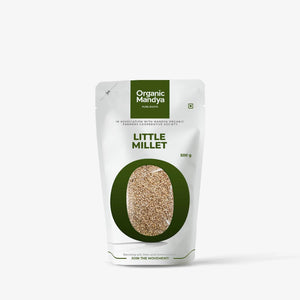
Little millet (saame / samai / kutki) is the smallest and most fibre-rich of India's common millets - a tiny grain with an outsized nutritional punch. At approximately 7.7 g of fibre per 100 g, little millet has one of the highest fibre contents among millets, creating exceptional satiety (you feel full on less food) and the gentlest glycaemic response. Its cooling thermal nature makes it the perfect summer grain across South India. Organic Mandya's organic little millet (Panicum sumatrense) is sourced from certified organic farms in Karnataka's millet-growing regions. Little millet has been a traditional crop of tribal and farming communities in peninsular India for over 3,000 years, unpolished, and ready to cook as a rice replacement with a delicate, slightly sweet flavour that even millet skeptics enjoy.
What Is Little Millet (Saame)?
Little Millet (Saame) is one of India's traditional grains - cultivated for thousands of years before rice and wheat monoculture replaced millet diversity across Indian agriculture. Millets are small-seeded grasses that grow with minimal water, no synthetic inputs, and remarkable resilience in poor soils. The Indian government declared 2023 as the International Year of Millets (IYoM) to revive these climate-smart, nutrient-dense grains.
Organic Mandya's organic little millet (saame) is sourced from NPOP-certified organic farms, unpolished (retaining the fibre-rich bran layer), and lab-tested for pesticide residues. The grain is available as whole millet and as flour for versatile cooking applications.
How Is Organic Little Millet (Saame) Different from Regular?
|
What We Are Comparing |
Organic Mandya |
Regular Market |
|
Farming |
Certified organic (NPOP); zero pesticides |
Conventional; pesticides possible |
|
Processing |
Unpolished (bran intact; full fibre + minerals) |
Often polished (bran removed) |
|
Fibre |
Full (bran layer retained) |
Reduced if polished |
|
Minerals |
Full iron, calcium, zinc (concentrated in bran) |
Lower if polished |
|
Colour |
Natural with bran specks |
Uniform if polished |
|
Certifications |
NPOP + FSSAI |
FSSAI only |
|
Lab reports |
trust.organicmandya.com |
Not published |
What Are the Health Benefits of Little Millet (Saame)?
1. Exceptionally high fibre (~7.7 g/100g) for satiety and gut health. Little millet's fibre content is among the highest of common millets. This creates powerful satiety - you eat less and feel full longer. The fibre feeds beneficial gut bacteria (prebiotic effect) and promotes regular bowel movements.
2. Excellent for weight management. The high fibre + moderate protein combination creates the ideal weight management grain: low caloric density, high satiety, slow glucose release, and minimal insulin spiking.
3. Natural cooling grain - ideal for summer. In South Indian traditional dietary wisdom, little millet is classified as cooling. It is the preferred summer grain in Tamil Nadu and Karnataka.
4. Delicate, mild flavour - easiest for beginners. Little millet has a subtle, slightly sweet taste that is less "millet-like" than bajra or ragi. Millet beginners and children often prefer little millet over stronger-flavoured varieties.
5. Cooks quickly and absorbs flavours well. Little millet cooks in 15-18 minutes, absorbs sambar, rasam, and curry flavours beautifully, and has a light, fluffy texture when properly cooked.
6. Rich in B vitamins and minerals. Provides niacin, thiamine, riboflavin, iron, and zinc for energy metabolism, immunity, and blood health.
What Is Inside Little Millet? (Nutrition per 100g, unpolished)
|
Nutrient |
Per 100g |
Rice (polished) |
Advantage |
|
Protein |
~7.7 g |
6.8 g |
13% more |
|
Fibre |
~7.7 g |
0.2 g |
38x more than rice |
|
Iron |
~1.3 mg |
0.7 mg |
Higher |
|
Calcium |
~17 mg |
10 mg |
Higher |
|
Calories |
~341 kcal |
345 kcal |
Slightly lower |
|
Gluten |
Zero |
Zero |
Both gluten-free |
Source: ICMR IFCTs, 2017; IIMR data
How Do I Use Little Millet (Saame) Every Day?
|
Preparation |
How |
Best For |
|
Little millet rice |
Rinse, add 2.5x water, cook 15-18 min |
Direct rice substitute; daily meals |
|
Little millet idli/dosa batter |
Ferment with urad dal |
Organic Mandya sells ready batter |
|
Little millet upma |
Cook with vegetables, spices |
Quick breakfast |
|
Little millet pongal |
Cook with moong dal, ghee, pepper |
South Indian comfort food |
|
Little millet kheer |
Cook in A2 milk with jaggery, cardamom |
Healthy dessert |
|
Batter (ready-made) |
Organic Mandya Little Millet Batter |
Instant idli/dosa |
Who Should Try Little Millet (Saame)?
Every Indian family can benefit from adding millets to their diet. ICMR-NIN 2024 dietary guidelines explicitly recommend millet inclusion for all Indians. The optimal approach is millet rotation - different millets across different meals and days - to access the varied nutritional profiles each millet offers. Little Millet (Saame) fits naturally into this rotation, providing unique benefits that other grains cannot match.
Store in an airtight container in a cool, dry place. Unpolished millets keep well for 6-12 months. Use within 2-3 months after grinding into flour for maximum freshness.
Explore More About Organic Millets
Finger Millet (Ragi) is just one of the many nutrient-rich millets that can be part of a balanced, wholesome diet. Each millet offers unique nutritional benefits—from the protein-rich foxtail millet to the fibre-packed little millet and the energy-boosting pearl millet. To understand the different types of millets, their health benefits, and how to include them in your everyday meals, Read the Complete Organic Millets Guide
How Do I Know This Little Millet (Saame) Is Really Organic?
NPOP certification, FSSAI licence (#11219322000392), batch-level lab reports at trust.organicmandya.com. Unpolished millet has visible bran texture and natural colour variation. Polished millet is uniformly smooth and pale. The bran layer is where most of the fibre, iron, and antioxidants reside - if it has been polished away, you are paying for empty calories.
Why Choose Organic Little Millet
Little millet is the gentle giant of the millet world. Despite being the smallest grain, it punches above its weight in fibre content and satiety. The cooling thermal nature makes it the perfect companion to ragi in South India's summer diet. While ragi provides calcium, little millet provides exceptional fibre - together, they cover the two most common nutritional gaps in Indian diets.
Organic Mandya offers little millet in multiple convenient formats: whole grain (cook as rice replacement), ready-made little millet idli/dosa batter (just pour and cook), and as part of millet-based ready-to-cook mixes. This range of convenience options makes little millet accessible even for families with no millet cooking experience.
The key to cooking little millet perfectly: use slightly less water than rice (2.5x instead of 3x), cook on low flame after boiling, and do not over-stir (it becomes mushy). Properly cooked little millet is light, fluffy, and absorbs accompanying flavours beautifully.
The summer millet strategy for South Indian families: In Karnataka and Tamil Nadu traditional practice, the ideal summer grain rotation is: Monday/Wednesday/Friday: little millet rice. Tuesday/Thursday: ragi mudde or ragi malt. Saturday: foxtail millet pulao. Sunday: regular rice (for special meals). This rotation provides cooling grains on most days (little millet + ragi), varied nutrition across the week, and the familiar comfort of rice on weekends. Over a month, this pattern delivers dramatically more fibre, protein, calcium, and iron than rice-only diets while keeping the family well-fed and satisfied.
Little millet for weight watchers: The exceptional fibre content (~7.7g/100g) creates a satiety signal that rice cannot match. In practical terms: you eat less little millet than rice to feel equally full. A typical rice serving is 150-200g cooked; most people find 100-120g of little millet equally satisfying. Over time, this natural portion reduction contributes meaningfully to weight management without calorie counting or willpower.
Looking to build a healthier, chemical-free kitchen beyond this topic? Explore our comprehensive guide covering everything from cold-pressed oils and A2 dairy to millets, spices, dals, fruits, vegetables, natural sweeteners, snacks, home essentials, and more. It brings together practical buying advice, ingredient comparisons, and trusted information to help you make informed choices for every part of your kitchen.
Explore the Complete Chemical-Free Kitchen Guide
FAQs
Q1. What are the benefits of little millet?
~7.7g fibre/100g (exceptional satiety), excellent for weight management, naturally cooling, low GI, delicate flavour suitable for beginners and children, and rich in B vitamins and minerals. The most gentle-on-the-palate millet available.
Q2. Is little millet good for weight loss?
Excellent - the high fibre content creates powerful satiety (feel full on less food), the low GI prevents insulin-driven fat storage, and the moderate protein supports lean body maintenance. Replace rice with little millet 3-4 times/week for gradual weight management.
Q3. How does little millet taste?
Mild, slightly sweet, and delicate. Less "grainy" or "earthy" than bajra or ragi. The most neutral-tasting millet - perfect for those who find other millets too strong.
Q4. Can I make idli and dosas with little millet?
Yes - Organic Mandya sells ready-made little millet idli/dosa batter. You can also make your own by fermenting little millet flour with urad dal (same process as regular batter, replacing rice with little millet).
Q5. Is little millet suitable for summer?
Yes - little millet has a cooling thermal effect, making it the ideal grain for hot weather. Traditional South Indian practice favours little millet and ragi in summer, and bajra in winter.


