


Isabgol (Psyllium Husk) in English: Names, Fibre per 100 g and How to Use
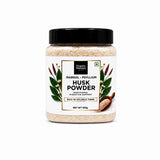
Isabgol is psyllium husk in English: the thin outer coat of the seeds of Plantago ovata, milled off and sold as a fibre product. Our pack label lists 77 g of dietary fibre per 100 g. Here are its names in Indian languages, its fibre per teaspoon, and how to use it safely.
Buy isabgol (psyllium husk) from Organic Mandya

What is isabgol made of?
Isabgol is made from the seeds of Plantago ovata, a small plant also called blond psyllium. Each seed has a thin, rosy-white coat: the husk. Millers separate it from the seed and clean it. Milled finer, it is sold as isabgol powder or psyllium husk powder.
In India, isabgol is grown commercially in Gujarat, Rajasthan and Madhya Pradesh as a winter crop, sown around October. India is the world's largest producer and exporter of psyllium, and Unjha in north Gujarat is a major trading and processing centre. Only about a quarter to 30% of the seed's weight comes out as husk.
Isabgol in English, Kannada, Telugu, Tamil and other languages
Most Indian languages use the same borrowed word, so the names sound alike. You will also see it spelt isabgul or ispaghula.
| Language | Name | Script | Notes |
|---|---|---|---|
| English | Psyllium husk | - | Also blond psyllium or ispaghula |
| Botanical | Plantago ovata | - | The plant whose seed coat is isabgol |
| Hindi | Isabgol; isabgol ki bhusi (the husk) | ईसबगोल; इसबगोल की भूसी | Bhusi means husk |
| Kannada | Isabugolu / Isabagolu | ಇಸಬುಗೋಲು / ಇಸಬಗೋಲು | Both spellings in V. Krishna's Kannada dictionary |
| Tamil | Isabgol | இசப்கோல் | Vikaspedia's crop guide also lists iskol |
| Sanskrit | Snigdhabijam | स्निग्धबीजम् | Sanskrit name for the plant |
In Telugu, Malayalam, Marathi and Gujarati it goes by the same borrowed name, isabgol (sometimes spelt isabgul). We found several different script spellings for these languages and could not confirm one from a dictionary, so we have not printed them here.
Isabgol seeds, husk and powder: what is the difference?
- Isabgol seeds (isabgol beej): the whole seed, with the husk still on.
- Isabgol husk (bhusi, sat isabgol): the seed coat alone, as light, papery flakes. "Sat isabgol" is a common shop name for the husk.
- Isabgol powder (psyllium husk powder): the husk milled finer. It mixes more evenly and starts to thicken quickly, so stir it and use it straight away.
Why isabgol swells in water
The husk carries mucilage, a slippery, gum-like kind of soluble fibre. Mucilage absorbs water and sets into a clear, colourless gel, which is why a spoon of isabgol in a glass of water turns thick within minutes. This gel makes the husk useful in the kitchen, and it is why you must always take it with plenty of liquid.
Soaked sabja and chia seeds form a similar gel, but around the whole seed.
Isabgol fibre and calories per 100 g
These values are the ones printed on our pack's nutrition label, which marks them as approximate. They are not IFCT or USDA figures. The per-teaspoon column is our own arithmetic, using the label's measure of 1 teaspoon = 5 g.
| Nutrient | Per 100 g | Per teaspoon (5 g) |
|---|---|---|
| Energy | 191 kcal | about 10 kcal |
| Dietary fibre | 77.0 g | about 3.9 g |
| Carbohydrate | 85.0 g | about 4.3 g |
| Total sugars | 0 g | 0 g |
| Protein | 2.4 g | about 0.1 g |
| Total fat | 0.5 g | less than 0.1 g |
| Sodium | 35 mg | about 2 mg |
Source: Organic Mandya Isabgol (Psyllium Husk Powder) 100 g pack, nutrition information (approx.). Per-teaspoon values are worked out from the per-100 g figures. The label's 85 g carbohydrate figure includes the 77 g of dietary fibre.
As a cross-check, the Norwegian Food Composition Table (Matvaretabellen), using Swedish Food Agency data, lists psyllium husk at 78 g dietary fibre and 206 kcal per 100 g, close to our label. Husk is fluffy, so if you track fibre closely, weigh your teaspoon once.
For other everyday foods that add fibre to Indian meals, see our guide to high-fibre foods in India.
Benefits of isabgol: what it gives you
Isabgol is sold in India mainly as a fibre supplement. As a food, it gives you:
- A lot of fibre in a small amount: about 3.9 g in a 5 g teaspoon, by our label.
- Very little else: no sugar, almost no fat and little sodium.
- No taste of its own: ours is unflavoured and unsweetened, so it takes on the taste of what you mix it into.
- A kitchen binder: its gel holds water and binds doughs.
How to use isabgol in the kitchen
In water, buttermilk or juice
Our pack's directions: stir 1 teaspoon (5 g) into a glass of water, mix well and drink immediately, then drink another glass of water. Buttermilk or juice work in place of water; a thin masala buttermilk suits it well. Do not let the glass stand, as it thickens within minutes.
In smoothies and curd
Blend a teaspoon into a smoothie or stir it into curd just before eating, with a little extra liquid. For seeds you can see and bite, compare chia seeds vs flax seeds.
In rotis and baking
Bakers use psyllium husk in bread made without wheat: its gel holds water and gives the dough structure that gluten would normally give. A 2021 study in the journal Foods reported better gluten-free bread quality with it. At home, some cooks add a little to jowar or ragi roti dough so it rolls without cracking. Add a little extra water and rest the dough for a few minutes.
Allergen note: the allergen line on our current pack reads "Contains wheat. Packed in a facility that also handles nuts." If you or someone you cook for must avoid wheat or gluten, do not use this pack, in drinks or in cooking, and always read the allergen line on any isabgol you buy.
Safety: always take isabgol with enough water
Because isabgol swells, dry husk or a thick, half-mixed drink can block the throat. In the United States, over-the-counter medicines that contain psyllium in dry form must carry a choking warning for this reason (FDA rule 21 CFR 201.319). The points below follow that warning, our pack label and MedlinePlus (US National Library of Medicine).
- Always mix it with at least a full glass (about 240 ml) of water or other liquid and drink it straight away. Never swallow the dry powder.
- Do not take it if you have difficulty swallowing. If you get chest pain, vomiting, or trouble swallowing or breathing after taking it, get medical help at once.
- If you must avoid wheat or gluten, see the allergen note above.
- Keep it out of reach of children. Our pack says it is not recommended for children below 6 years.
- If you are pregnant or breastfeeding, have a medical condition, or take any medicine, ask your doctor first. MedlinePlus advises against taking certain medicines within 3 hours of psyllium, so ask how far apart to take yours.
FAQs
Q1. What is isabgol?
Isabgol is psyllium husk, the outer coat of Plantago ovata seeds. It is sold as flaky husk or finer powder, is high in fibre, and forms a gel in water.
Q2. What is isabgol made from?
Isabgol is made from Plantago ovata seeds, milled to separate the husk, which is then cleaned and packed. In India the crop is grown mainly in Gujarat, Rajasthan and Madhya Pradesh.
Q3. How much fibre is in 100 g of isabgol?
Our pack label lists 77.0 g of dietary fibre and 191 kcal per 100 g. The Norwegian Food Composition Table gives 78 g fibre and 206 kcal per 100 g for psyllium husk.
Q4. How much fibre is in 1 teaspoon of isabgol?
About 3.9 g of fibre and about 10 kcal, using our label's measure of 1 teaspoon = 5 g.
Q5. What is isabgol called in Kannada, Telugu and Tamil?
In Kannada it is isabugolu or isabagolu (ಇಸಬುಗೋಲು / ಇಸಬಗೋಲು). In Tamil it is isabgol (இசப்கோல்). In Telugu it goes by the same borrowed name, isabgol. In Hindi it is ईसबगोल, and the husk is isabgol ki bhusi.
Q6. What is the difference between isabgol seeds and husk?
Isabgol seed is the whole seed; the husk is only its outer coat. The gel-forming mucilage comes from the husk, which is why husk and husk powder are what most people buy. "Sat isabgol" is a common shop name for the husk.
Q7. How do I take isabgol safely?
Stir it into at least a full glass of liquid, drink it immediately, then drink another glass of water. Never take it dry or if you have difficulty swallowing. Our current pack's allergen line says it contains wheat. If you are pregnant, take medicines or have a medical condition, ask your doctor first.
Keep isabgol in your kitchen

About this article
General food information from Organic Mandya, not medical advice. Sources:
- Organic Mandya Isabgol (Psyllium Husk Powder) 100 g: product page and pack label.
- Matvaretabellen, Norwegian Food Composition Table (psyllium husk, ID 05.465; Swedish Food Agency data).
- ICAR, Indian Horticulture: "Cultivating isabgol in rainfed areas".
- Vikaspedia (Government of India): isabgol crop guide.
- V. Krishna's Kannada-English Dictionary (alar.ink); Hindi Wikipedia, ईसबगोल; Wikipedia, "Psyllium".
- Sharma, Mazumder and Nautiyal (2014), rheology of isabgol husk; "Psyllium Improves the Quality and Shelf Life of Gluten-Free Bread", Foods, 2021 (PMC8145964).
- US FDA, 21 CFR 201.319; MedlinePlus (NIH), psyllium.


